Showing posts with label Brazil. Show all posts

Friday, December 19, 2008

The Islam is determined to destroy the West!
We will let this happen?


Versão em português


The Meaning of Mumbai
by Thomas Sowell

Will the horrors unleashed by Islamic terrorists in Mumbai cause any second thoughts by those who are so anxious to start weakening the American security systems currently in place, including government interceptions of international phone calls and the holding of terrorists at Guantanamo?

Maybe. But never underestimate partisan blindness in Washington or in the mainstream media where, if the Bush administration did it, then it must be wrong.

Contrary to some of the more mawkish notions of what a government is supposed to be, its top job is the protection of the people. Nobody on 9/11 would have thought that we would see nothing comparable again in this country for seven long years.

Many people seem to have forgotten how, in the wake of 9/11, every great national event-- the World Series, Christmas, New Year's, the Super Bowl-- was under the shadow of a fear that this was when the terrorists would strike again.

They didn't strike again here, even though they have struck in Spain, Indonesia, England and India, among other places. Does anyone imagine that this was because they didn't want to hit America again?

Could this have had anything to do with all the security precautions that liberals have been complaining about so bitterly, from the interception of international phone calls to forcing information out of captured terrorists?

Too many people refuse to acknowledge that benefits have costs, even if that cost means only having no more secrecy when making international phone calls than you have when sending e-mails, in a world where computer hackers abound. There are people who refuse to give up anything, even to save their own lives.

A very shrewd observer of the deterioration of Western societies, British writer Theodore Dalrymple, said: "This mental flabbiness is decadence, and at the same time a manifestation of the arrogant assumption that nothing can destroy us."

There are growing numbers of things that can destroy us. The Roman Empire lasted a lot longer than the United States has lasted, and yet it too was destroyed.

Millions of lives were blighted for centuries thereafter, because the barbarians who destroyed Rome were incapable of replacing it with anything at all comparable. Neither are those who threaten to destroy the United States today.

The destruction of the United States will not require enough nuclear bombs to annihilate cities and towns across America. After all, the nuclear destruction of just two cities was enough to force Japan to surrender-- and the Japanese had far more willingness to fight and die than most Americans have today.

How many Americans are willing to see New York, Chicago and Los Angeles all disappear in nuclear mushroom clouds, rather than surrender to whatever outrageous demands the terrorists make?


Neither Barack Obama nor those with whom he will be surrounded in Washington show any signs of being serious about forestalling such a terrible choice by taking any action with any realistic chance of preventing a nuclear Iran.

Once suicidal fanatics have nuclear bombs, that is the point of no return. We, our children and our grandchildren will live at the mercy of the merciless, who have a track record of sadism.

There are no concessions we can make that will buy off hate-filled terrorists. What they want-- what they must have for their own self-respect, in a world where they suffer the humiliation of being visibly centuries behind the West in so many ways-- is our being brought down in humiliation, including self-humiliation.

Even killing us will not be enough, just as killing Jews was not enough for the Nazis, who first had to subject them to soul-scarring humiliations and dehumanization in their death camps.

This kind of hatred may not be familiar to most Americans but what happened on 9/11 should give us a clue-- and a warning.

The people who flew those planes into the World Trade Center buildings could not have been bought off by any concessions, not even the hundreds of billions of dollars we are spending in bailout money today.

They want our soul – and if they are willing to die and we are not – they will get it.


Thomas Sowell was born in North Carolina still young he joined the Marine Corps (U.S. Navy), where he became photographer in the Korean War. After leaving the service in the Marines, Sowell came to Harvard University, graduated in economics, he went on to receive his master's in economics from Columbia University and a doctorate in economics from the University of Chicago. Thomas Sowell also taught economics at the following institutions: Cornell University, Rutgers University, Amherst University, Brandeis University and the University of California, also published several books and numerous articles and essays. Sowell began his career as a columnist for newspapers in the late 70, came to win the prize "Francis Boyer" in The American Enterprise Institute in 1990. Currently Sowell is a senior fellow at the Hoover Institute in Stanford, Calif. and maintains a column in the prestigious site "Townhall.com"


Published in "Townhall.com".
Tuesday, December 09, 2008


Previous post published in English: The Monster at the Bottom of the Abyss – J. R. Nyquist


Friday, April 25, 2008

Tupiniquins go home!

Figura: Stars and Stripes of the Brazilian Empire. Cucarachas: Burn this flag!


Nós, os imperialistas
por João Mellão Neto

Isso, um dia, haveria fatalmente de acontecer. De Lenin para cá, o inimigo dos povos pobres eram os países desenvolvidos, que usavam até mesmo a força para obrigar aqueles a comerciar com desvantagem. Segundo Vladimir Ulianov - nome verdadeiro do líder da Revolução Russa, os ricos não exploravam mais os pobres em seus próprios países, preferiam unir suas forças para tirar proveito das nações menos desenvolvidas. Inimigos, por exemplo, eram os países ricos da Europa, aqueles que já haviam realizado as suas revoluções industriais.

Da 2ª Grande Guerra para cá, o inimigo mudou de endereço. Donos de praticamente metade das riquezas do mundo, era natural a eleição, como alvo preferencial, dos Estados Unidos da América. A nossa América Latina não ficou indiferente a esse movimento. Muita tinta e muito papel foram gastos por aqui para esconjurar os demônios do norte. O maior investidor em cada um dos países da América ibérica e também o maior parceiro comercial, era previsível que a opulência norte-americana despertasse a cobiça dos seus irmãos latinos, uma vez que “não havia outra explicação para o fato de eles serem tão ricos e os demais, tão pobres”. Educação, instituições, desenvolvimento tecnológico, nada disso era levado em conta, para não desafinar o canto da procissão. Os ricos são ricos tão-somente porque exploram os pobres e ponto final.

A tese, nestas plagas, ganhou finalmente a sua bíblia, o seu livro sagrado, com a publicação da rancorosa obra do uruguaio Eduardo Galeano "As Veias Abertas da América Latina", no início da década de 1970. Escritor talentoso, Galeano pôs a sua pena a serviço da ideologia e conseguiu pintar com cores demoníacas até onde nem sequer um pequeno capeta havia. "A América Latina estava inteirinha a serviço dos EUA!", concluía, alarmado, o escritor.

Li esse livro nos meus primeiros anos de universidade. Embora tudo o que fora afirmado ali fosse de difícil comprovação, o fato é que as verdades convenientes não carecem ser chanceladas pelos fatos: acredita-se nelas e pronto. Após sua leitura, tive ímpetos de tomar o primeiro quartel que avistasse. Ainda bem que não o fiz. A História é uma senhora caprichosa e ainda haveria de dar muitas voltas nos 35 anos posteriores.

A virada do jogo se deu com a posse, como presidente da Venezuela, do coronel Hugo Chávez. Surpresa! No índex do ditador, o Brasil constava pela primeira vez como um dos países exploradores e vilões. Como isso era possível? Pois não foi aqui que se produziu a maior tonelagem de livros antiimperialistas? É verdade, como também é verdade que nós possuímos o maior território da América Latina, temos a economia mais desenvolvida e, ainda por cima, falamos um idioma diferente dos demais na região. Não basta isso para assegurar a nossa candidatura ao clube das nações odiáveis?

Logo depois de Chávez, tomou o poder na Bolívia o pseudo-índio Evo Morales, que, já no dia de sua posse, declarou ser o Brasil a principal potência a ser combatida e anunciou, para logo em seguida, a expropriação de duas usinas brasileiras em território boliviano. A promessa foi cumprida na íntegra. Em seguida, assomou ao poder, no Equador, mais um líder típico, Rafael Correa. Somados estes ao casal Kirchner, da Argentina, que nunca escondeu o seu vezo peronista, e mais Alan García, que busca cumprir as suas promessas de austeridade, mas o passado o condena, temos um quadro de volta ao passado, quando todas as nações da América do Sul rezavam pela cartilha populista.

O novo populismo - que acaba de levar a Presidência do Paraguai - é mais sofisticado e complexo do que o antigo. A base popular destes novos regimes não é mais composta pelos sindicatos organizados, mas sim pelos “despossuídos”, uma massa disforme, geralmente de origem rural, que se caracteriza por “não possuir alguma coisa: seja terra, seja teto, seja o que for”. É a essa gente que arengam os novos messias, prometendo o Céu na Terra e benesses de todos os tipos. A origem dos recursos para tanto, como no populismo tradicional, é incerta. Geralmente se alega que vão conseguir concessões comerciais de países vizinhos mais desenvolvidos.

O ódio aos Estados Unidos, como não podia deixar de ser, está presente no ideário dos novos líderes, já que nossos irmãos do norte continuam sendo a nação mais rica do planeta. Mas, em se tratando de mágoa, os neopopulistas têm outras prioridades de que cuidar. O Brasil é a principal delas e se enquadra perfeitamente no perfil de “imperialista odiável”: temos um território avantajado, um parque industrial muito mais moderno e desenvolvido do que os dos nossos vizinhos e, suprema heresia, quase todos dependem do comércio conosco para a saúde de suas economias.

Quem estudou na minha época pode enrolar as suas bandeiras de luta, porque agora os imperialistas somos nós. Todo o rancor que nós destilávamos contra os Estados Unidos agora se voltou contra o Brasil. Aqueles, dentre nós, que derramaram lágrimas ao ler o livro de Eduardo Galeano hoje repensam se é totalmente verdadeira a retórica repleta de impropérios do escritor uruguaio. Afinal, os mesmos argumentos de que ele se valeu para insuflar os intelectuais latino-americanos contra os norte-americanos estão, agora, sendo usados contra nós.

O que mais impressiona nesse novo quadro político é o comportamento ambíguo do presidente Lula. O fato é que ele tem de bajular todas as correntes que o elegeram duas vezes para ocupar o Planalto. E isso implica, entre outras coisas, prestar reverência a todos os líderes sul-americanos que surgirem brandindo uma bandeira com tons avermelhados.

Triste sina a nossa!


João Mellão Neto, nasceu na cidade de São Paulo, SP em 06/11/1955, filho de comerciante de café e agro-pecuarista estudou administração de empresas na Fundação Getúlio Vargas e jornalismo na Fundação Cásper Líbero. João Mellão Neto é um dos jornalistas mais lidos, comentados e acreditados da imprensa de São Paulo e do Brasil. Seus artigos são publicados, todas as sextas-feiras na página 2 do jornal "O Estado de São Paulo" e, quinzenalmente, no "Florida Review", revista em língua portuguesa que circula na comunidade brasileira em Miami, EUA. Como escritor já publicou diversos livros na área do "pensamento político liberal", tendo em vista que João Mellão também teve uma carreira política bastante diversificada para sua idade, sendo quatro vezes secretário municipal, cumpriu dois mandatos de deputado federal e foi ministro de Estado.


Publicado no jornal " O Estado de S. Paulo".
Sexta-feira, 25 de abril de 2008.


O reinado da burrice – Benedicto Ferri de Barros

Sunday, August 05, 2007

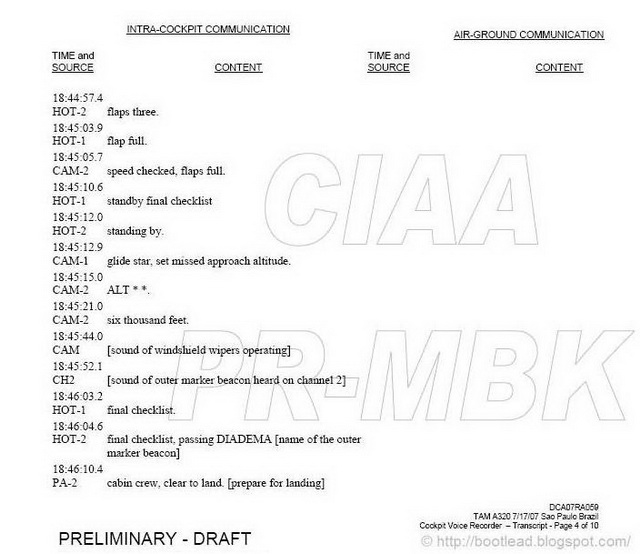
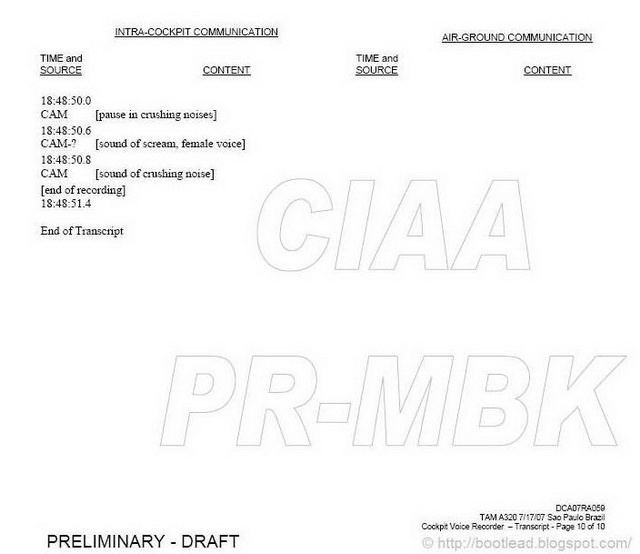
Transcript of Cockpit Voice Recorder from Flight 3054-TAM Airlines which crashed in Congonhas Airport, Brazil.

Foto: © Juliano Damásio


Above a photo of the Airbus A320-233 (TAM PR-MBK) taking off in the Congonhas airport, in the same runway of
the disaster on July 17, 2007 (died around 200 persons).


Transcript of Cockpit Voice Recorder

Cockpit Voice Recorder – Legend.


Cockpit Voice Recorder – Transcript of the Page 1 of 10.


Cockpit Voice Recorder – Transcript of the Page 2 of 10.


Cockpit Voice Recorder – Transcript of the Page 3 of 10.


Cockpit Voice Recorder – Transcript of the Page 4 of 10.


Cockpit Voice Recorder – Transcript of the Page 5 of 10.


Cockpit Voice Recorder – Transcript of the Page 6 of 10.


Cockpit Voice Recorder – Transcript of the Page 7 of 10.


Cockpit Voice Recorder – Transcript of the Page 8 of 10.


Cockpit Voice Recorder – Transcript of the Page 9 of 10.


Cockpit Voice Recorder – Transcript of the Page 10 of 10.


Links for other photos of the TAM PR-MBK. (Click on the thumbnail to see the original photo)


Thursday, November 02, 2006

A OTAN será a ONU dos países liberais democratas.


O Brasil não será convidado para este jogo!
English version.


A OTAN contra os jihadistas
por Daniel Pipes

Quando era secretário de Estado, Colin Powell certa vez definiu a Organização do Tratado do Atlântico Norte como “a maior e mais bem-sucedida aliança da história”. É difícil contestar essa definição, pois foi tal o sucesso da OTAN em conduzir e vencer a Guerra Fria, que sequer precisou lutar.

Mas hoje essa aliança tão importante vive o ápice do que José María Aznar, primeiro-ministro da Espanha entre 1996 e 2004, chama de “possivelmente a maior e mais séria crise de toda a sua história”. Um “clima de crise perpétua”, diz ele, cuja origem é a perda evidente de sua “raison d’être como organização, a falta de uma missão específica”.

Os motivos dessa crise são simples de explicar. De sua fundação em 1949 até o colapso da União Soviética em 1991, a OTAN foi o principal instrumento para a contenção do expansionismo soviético. Após derrotar a ameaça soviética, reformulou sua missão. Na década de 90, a OTAN tornou-se um veículo para o envio de forças voluntárias encarregadas de promover a segurança regional em lugares como a Bósnia e o Kosovo. E agora, depois do 11 de Setembro?

NATO: An Alliance for Freedom, um estudo curto, brilhante e de fácil aplicação publicado pelo instituto de Aznar, a Fundação de Análise e Estudos Sociais – FAES, revela que conter a União Soviética não era o objetivo fundamental da organização. A OTAN imbuíra-se, antes, do propósito mais positivo de “salvaguardar a liberdade, a herança e a civilização comuns aos povos [dos Estados membros], com base nos princípios da democracia, da liberdade individual e do Estado de Direito”.

A prova de que a missão da OTAN esteve sempre além de defender a democracia contra o comunismo tão-somente reside no fato de a organização ter abdicado do valor estratégico do território espanhol e sua força militar enquanto o país permaneceu sob o jugo do governo fascista de Francisco Franco. Apenas com a morte dele em 1975 e a democratização do governo, a Espanha é convidada a integrar a aliança em 1981.

Uma indicação de qual deveria ser o novo foco da OTAN surgiu no dia seguinte ao 11 de Setembro, quando a organização, pela primeira vez em seus cinqüenta e dois anos de história, invocou o artigo 5º. de seus estatutos, onde prevê que um ataque a um dos países membros é um ataque a todos eles. Assim, depois de uma década fazendo “guerras como assistência social”, a OTAN despertou abruptamente para a ameaça do radicalismo islâmico.

Aznar e a equipe da FAES analisam essa decisão crítica, afirmando que “o terrorismo islâmico é uma nova ameaça, cuja natureza global põe em risco a existência mesma dos signatários da OTAN”. Lembrando as ideologias totalitárias dos anos 30, eles advertem, com razão, que “deveríamos levar as ambições [islamistas] muito seriamente, por ridículas ou delirantes que pareçam”. Demonstrando verdadeira sagacidade, eles ressaltam que o terrorismo “é apenas a porção bélica de uma ofensiva muito mais ampla contra o mundo liberal e democrático”.

Logo, o objetivo da OTAN deve ser o de “combater o jihadismo islâmico e a proliferação de armas de destruição em massa especialmente, embora não exclusivamente, entre os grupos e os governos islâmicos”. Isso significa “colocar a guerra contra o jihadismo islâmico no centro da estratégia aliada” e que derrotá-lo será a “missão principal” da OTAN por longos anos.

Uma segunda recomendação essencial da OTAN: Uma Aliança para a Liberdade: que a OTAN convide à adesão plena países que sejam democracias liberais e também tenham capacidade e disposição para contribuir na guerra contra o jihadismo islâmico. O estudo enfatiza o ingresso de Israel na Aliança como “um passo extremamente importante”, e apóia a participação do Japão e da Austrália com status pleno. Além destes, eu proporia Taiwan, Coréia do Sul e Chile. Para encorajar outros Estados em situação difícil, o estudo sugere a condição de membro associado para países como a Colômbia e a Índia. Eu sugiro a inclusão do México e do Sri Lanka nessa lista.

Um tópico que a FAES não explicita, mas aborda indiretamente: a possibilidade de a OTAN substituir as Nações Unidas como o principal organismo internacional. À medida que a ONU desce de um ponto já baixo a profundidades ainda maiores, torna-se cada vez mais óbvio que, para se comportar de modo adulto, uma instituição mundial só deve reunir países democráticos. Uma nova organização pode ser criada do zero, claro, mas é mais simples, mais econômico e mais rápido construí-la sobre uma estrutura existente, sobretudo se de eficiência comprovada. A OTAN surge como a candidata natural, especialmente nos termos em que foi redefinida pela FAES.

Aznar e sua equipe desenvolveram o melhor plano já oferecido para combater o Islã radical. Os políticos estarão prontos para executá-lo?


Daniel Pipes é um dos maiores especialistas em Oriente Médio, Islã e terrorismo islamista da atualidade. Historiador (Harvard), arabista, ex-professor (universidades de Chicago e Harvard; U.S. Naval War College), Pipes mantém seu próprio site e dirige o Middle East Forum, que concebeu junto com Al Wood e Amy Shargel — enquanto conversavam à mesa da cozinha de sua casa, na Filadélfia — e que hoje, dez anos mais tarde, tem escritórios em Boston, Cleveland e Nova York. Depois do MEF, vieram o Middle East Quartely, o Middle East Intelligence Bulletin e o Campus Watch, dos quais ele participa ativamente. Juntos, esses websites recebem mais de 300 mil visitantes por mês. Por fazer a distinção sistemática entre muçulmanos não-islamistas e extremistas islâmicos, Daniel Pipes tem sido alvo de ataques contundentes. A polêmica gerada por sua nomeação, em 2003, para o Institute of Peace pelo presidente George Bush apenas confirmou o quanto as idéias de Pipes incomodam as organizações islamistas e outros interessados em misturar muçulmanos e terrorismo. Daniel Pipes é autor de 12 livros, entre eles, Militant Islam Reaches America, Conspiracy, The Hidden Hand e Miniatures, coletânea lançada em 2003.


Publicado no The New York Sun.
Terça-feira, 03 de outubro de 2006.


The NATO will be the UN of the liberal democratic countries.


Brazil will not be invited for this game!
Versão em português

NATO Fights the Jihadis
by Daniel Pipes

When he was secretary of state, Colin Powell once called the North Atlantic Treaty Organization "the greatest and most successful alliance in history." It's hard to argue with that description, for NATO so successfully waged and won the Cold War, it didn't even have to fight.

But this greatest alliance is now in the throes of what José María Aznar, the former prime minister of Spain between 1996 and 2004, calls "possibly the greatest and most serious crisis in its entire history." A "climate of perpetual crisis," he writes, results from a perceived loss "of the organization's raison d'être, the lack of a mission."

The origins of this crisis are simple to explain. From its founding in 1949 until the collapse of the Soviet Union in 1991, NATO served as the main instrument to contain Soviet expansionism. After vanquishing the Soviet threat, its mission changed. In the 1990s, NATO became a vehicle for voluntarily sending forces to promote regional security in places like Bosnia and Kosovo. And what now, post-9/11?

In a short, brilliant, and operational study, NATO: An Alliance for Freedom, published by Mr. Aznar's think-tank, Fundación para el Análisis y los Estudios Sociales, or FAES, we learn that containing the Soviet Union was not the organization's founding principle. Rather, NATO was imbued with the more positive goal "to safeguard the freedom, common heritage and civilization of [the member states'] peoples, founded on the principles of democracy, individual liberty and the rule of law."

Proof that NATO was always mandated to defend democracy against more than Communism can be found in its having forgone the strategic value of Spanish territory and its military force so long as that country remained under the thumb of Francisco Franco's fascist government. Only after he died in 1975 and the government became democratic did Spain get an invitation to join the alliance in 1981.

One indication of what NATO's new focus should be came a day after September 11, when NATO for the first time ever in its 52-year history invoked Article V of its founding treaty, with its provision proclaiming that an attack on one is an attack on all. Thus did NATO, after a decade of "war as social work," abruptly awake to the threat of radical Islam.

Mr. Aznar and the FAES team build on that critical decision, stating that "Islamist terrorism is a new shared threat of a global nature that places the very existence of NATO's members at risk." Recalling the totalitarian ideologies of the 1930s, they correctly warn that "We should take [Islamist] ambitions very seriously, no matter how ridiculous or delirious they may seem." With real insight, they also stress that terrorism "is only the war-like part of a much more far-reaching offensive against the liberal and democratic world."

NATO's mission, therefore, must be "to combat Islamic jihadism and the proliferation of weapons of mass destruction mainly, but not exclusively, among Islamic groups and governments." This means "placing the war against Islamic jihadism at the center of the Allied strategy" and that defeating Islamic jihadism will remain the organization's "key mission" for many years.

A second key recommendation in NATO: An Alliance for Freedom: That NATO invite for full membership countries that are both liberal democracies and able and willing to contribute to the war against Islamic jihadism. The study emphasizes bringing Israel into the Alliance as "an extremely important step," and it endorses Japan and Australia for full membership. I might propose, in addition, Taiwan, South Korea, and Chile. To encourage other, struggling, states, the study suggests an associate membership for countries like Colombia and India. To which I suggest that Mexico and Sri Lanka could join their ranks.

One topic that FAES does not explicitly take up but hints at: that NATO could replace the United Nations as the key world body. As the UN sinks from one low spot to ever-slimier depths, it becomes increasingly obvious that for an international organization to behave in an adult manner requires limiting its membership to democratic states. A new organization could be created from scratch, to be sure, but it is easier, cheaper, and quicker to build on an existing structure especially one with proven capabilities. NATO offers itself as the obvious candidate, especially as reconceptualized by FAES.

Mr. Aznar and his team have produced the best plan yet for confronting radical Islam. Will politicians take it up?


Daniel Pipes is director of the Middle East Forum and a prize-winning columnist. Domestically, he appears in the New York Sun and the Philadelphia Evening Bulletin. Abroad, he appears in Israel’s Jerusalem Post, Italy’s L’Opinione, Spain’s La Razón, the Australian, and Canada’s Globe and Mail. He received his A.B. (1971) and Ph.D. (1978) from Harvard University, both in history, and spent six years studying abroad, including three years in Egypt. Mr. Pipes speaks French, and reads Arabic and German. He has taught at the University of Chicago, Harvard University, and the U.S. Naval War College. He served in various capacities in the U.S. government, including two presidentially-appointed positions, vice chairman of the Fulbright Board of Foreign Scholarships and member of the board of the U.S. Institute of Peace. He was director of the Foreign Policy Research Institute in 1986-93.


Published in The New York Sun.
Tuesday, October 3, 2006.


Sunday, October 29, 2006

A new communist continent is being born.


The new Brazilian flag will be this?
Click here to view image in original size.

Bird’s Eye View of the News
by Atila Sinke Guimarães

WHAT’S OLD AND NEW IN COMMUNISM? - An internal document for members of the Chinese Communist Party regarding its position on religion was leaked to Asia News Service, an important news agency based in Rome. The document was issued in November by the Communist Party’s Department of Propaganda and Asia News reported it in early December. I transcribe it from The Tablet (December 11, 2004, p. 33).

The document laments the “Westernizing” and “disintegrating” influence of religious faith and cautions officials to patiently and meticulously work to move the Chinese people away from religious beliefs. It is especially concerned about the growing interest in religion among the young and educated. According to the document, “fatuity – weakness or imbecility of mind – and superstitions” must be eliminated and replaced with “scientific thinking.”

An education in the “natural sciences” is vital so that the people will have “the basic knowledge about life, the rule of human evolution, and correctly deal with various natural phenomena, birth, ageing, disease, and death,” it instructed. Integrating Marxism more fully into the educational system is another focus, and the paper reiterates the party’s absolute monopoly over education. Marxism must permeate all activities in the lives of the population, “directing people’s cultural and sports activities, satisfying people’s spiritual and cultural demands, and popularizing knowledge on laws, rules and regulations,” so as “to change old habits into new ones.”

This document provides us a clear picture of the internal orientation Communism is following in China. An orientation, one should note, not so different from that of the China of Mao-Tse-Tung, which considered religion “the opium of the people.” The emergence of this document provides a good opportunity to show the naivety of the Western man who believe that Chinese Communism has changed.

Unfortunately, based on this supposed change, the West is pouring hundreds of billion of dollars a year into this regime, and also is allowing thousands of Chinese immigrants to enter our countries. The labor force of communist China, increasingly utilized by Western businesses to provide cheaper products (and fill their pockets with money), has a reverse side: we are becoming dependent on this work force. Tomorrow, China can blackmail us by shutting off its labor force. We would face a difficult choice: either we experience a collapse in our industry and commerce or we cave in and do whatever the communist Chinese leaders might demand from us.

This “shrewdness” of Western businessmen to turn a quick profit is slowly but steadily making a considerable part of the Western economy dependent on an undependable communist China. In the long run, the maneuver does not appear shrewd at all. More likely, it results from a foolish naiveté, reminding me of that famous communist prediction that the West would give communist countries the rope they would use to hang us. Actually, it is the same old communist plan taking advantage of new allies: Western businessmen.

URUGUAY BECOMES ANOTHER COMMUNIST COUNTRY – Understandably, the last U.S. presidential election diverted attention from what happened in the Uruguayan elections, which also took place in November. But now is a good moment to analyze what occurred there. In that small South American country situated between Brazil and Argentine, Communism for the first time effectively came to power.

The new president, Tabare Vasquez, is the candidate of the Broad Front, a leftist political group dominated by nothing less than an old terrorist tupamaro movement. Tupamaro was the Uruguayan communist guerrilla movement of the ‘60s and ‘70s that was persecuted by several governments. Finally, it moved above ground, transforming itself into a small political party that is the main political force of the Broad Front today.

Soon after the elections, Vasquez declared: “We want to dedicate this triumph to those giants who are no longer with us,” referring to Raul Sendic, the radical communist founder of the tupamaro movement and Liber Seregni, founder of the Broad Front. Thanks to them, Tabare Vasquez continued, “hope won out over fear.” He was repeating a popular slogan exploited in Lula’s victory in Brazil. Different from Lula, however, the new Uruguayan president will govern counting on the majority in Congress. The man who received the most votes in this refurbished Congress was Pepe Mujica, another tupamaro guerrilla who was in jail for 14 years (Adista, November 15, 2004, pp. 10-1).

This election adds yet another nation to the extreme-left ensemble of countries in South America that is severely against the U.S. and favorable to Communism – Brazil, Argentina, Venezuela, and Uruguay.

BOLIVIA’S SOCIALIST PARTY RECORDS ENORMOUS GROWTH – On December 5, mayors of 327 cities were elected in municipal elections of Bolivia. The results reveal an enormous growth in importance of the Movement Toward Socialism – MAS.

These city elections represent a defeat for the traditional parties and a triumph for the left. According to Green Left Weekly, MAS took around 280 of 327 cities, even though it did not win in any of the 10 main cities. Yet in those cities, the situation is not secure. Consider that it came second — with around 20% of the vote — in both the capital La Paz, and in El Alto, whose population was decisive in ousting the president during the October 2003 uprising. In Potosi, capital of a southern state rich in silver mines, MAS did not win, but the elected mayor is from a party inspired by the thinking of Ché Guevara, the famous guerrilla leader who was second to Fidel Castro in the Cuban revolution.

In October 2003, Bolivia was the theater for a populist-leftist insurrection against President Sanchez Lozada, allegedly for his policy of selling Bolivian gas to the United States. The violent riots that shook the whole country obliged Lozada to renounce the presidency and flee Bolivia. He was replaced by vice-president Diego Mesa, sympathetic with the rioters. The principal leader of the insurrection was Evo Morales, a key figure of MAS. Morales, by the way, was defeated by Sanchez in the 2002 elections by a narrow margin of the vote (22.5% to 20%).

MAS is composed primarily of cocaleros (the native coca growers), mine workers, and peasants. It is supposed to represent the 69 indigenous peoples who make up 80% of Bolivia’s 9.3 million population. In the 1999 municipal elections, MAS took only 3% of the vote. Three years later, in the 2002 presidential elections, the MAS candidate Morales had 20% of the vote. The BBC estimates that in the 2004 elections, MAS got 25% of the ballots cast; Green Left estimates the number at 30%. It is a considerable percentage in a vote divided among 17 political parties with 28% of voters abstaining.

The rapid rise of MAS, an implacable foe of the United States, represents a rejection of neo-liberal policies and a general defeat for the establishment parties of Bolivia. The political situation born from these elections projects a future 2007 presidential race between Evo Morales, who would bring under his banner all the leftist forces, and the neo-liberal candidate Jorge Quiroga. Should nothing change on the panorama, the country could well experience what happened in Brazil, i.e, put a Communist worker in the presidency.

Before the recent elections, Morales made this prediction at the final MAS rally: “The time is approaching when we Bolivians will be able to govern ourselves, without programs imposed by the IMF [International Monetary Fund] and without corruption.” Morales emphasized “his solidarity with Cuba and Venezuela and with the anti-neo-liberal movements that have risen up in Brazil and other Latin American nations” (Green Left Weekly, December 15, 2004; BBC News, December 6; Inter Press Service, December 6; Prensa Latina, November 30 and December 6, 2004 – all online editions).


This is the future South America map.
This map shows the blindness of those
who say that Communism is dead.


It is difficult to understand why the West remains oblivious to this new Communist invasion of South America. It seems that those in the United States who want to defend the remains of Christendom against Communism should be wasting no time in asking what to do in face of the rapid transformation of South America into a red continent.

Published in the site Tradition in Action.
Friday, January 7, 2005.


Monday, October 02, 2006

Em 2007 estaremos: "SOB NOVA DIREÇÃO".


Click aqui para ver a foto no tamanho original.

No dia 02 de Janeiro de 2007, um senhor idoso se aproxima do Palácio da Alvorada e, depois de atravessar a Praça dos Três Poderes, falou com o "Dragão da Independência" que montava guarda:

"Por favor, eu gostaria de entrar e me entrevistar com o Presidente Lula."

O soldado olhou para o homem e disse: "Senhor, o Sr. Lula não é mais presidente e não mora mais aqui desde ontem."

O homem disse: "Está bem", e se foi.

No dia seguinte, o mesmo homem idoso se aproximou do Palácio da Alvorada e falou com o mesmo "Dragão da Independência":

"Por favor, eu gostaria de entrar e me entrevistar com o Presidente Lula."

O soldado novamente disse: "Senhor, como lhe falei ontem, o Sr. Lula não é mais presidente nem mora aqui desde anteontem."

O homem agradeceu e novamente se foi.

Dia 04 de janeiro ele volta e se aproxima do Palácio Alvorada e falou com o mesmo guarda:

"Por favor, eu gostaria de entrar e me entrevistar com o Presidente Lula."

O soldado, compreensivelmente irritado, olhou para o homem e disse: "Senhor, este é o terceiro dia seguido que o Senhor vem aqui e pede para falar com o Sr. Lula. Eu já lhe disse que ele não é mais o presidente, nem mora mais aqui. O Senhor não entendeu?"

O homem olhou para o soldado e disse: "Sim, eu compreendi perfeitamente, mas eu ADORO ouvir isso!"

O soldado, em posição de sentido, prestou uma vigorosa continência e disse:

"Até amanhã, Senhor!!!"


Copyright © 2004-2019 Bootlead